

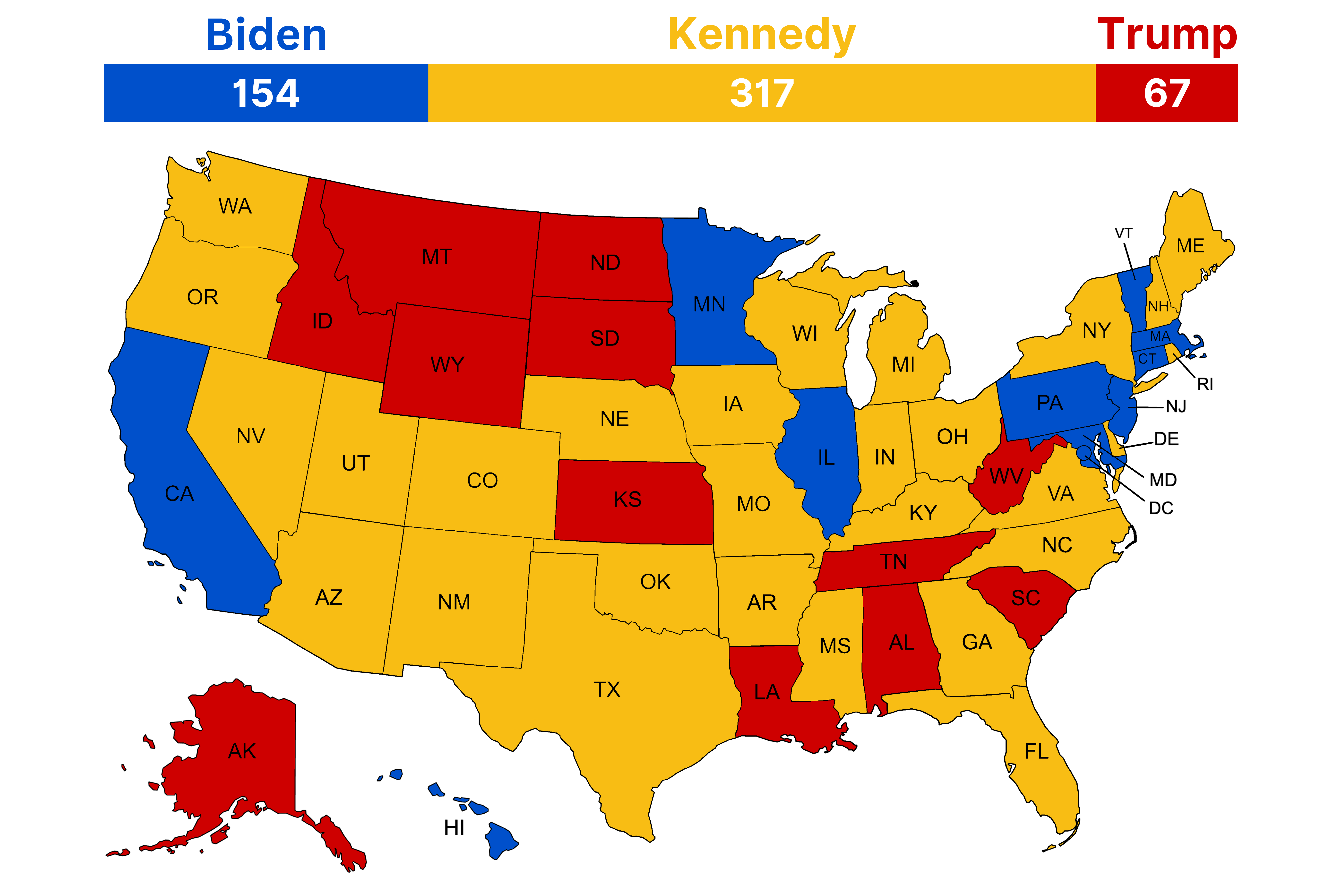
The 2024 Presidential election is shaping to be a three-way race between former President Donald Trump, President Joe Biden, and independent candidate Robert Kennedy Jr. Considering presidential elections in the United States require a candidate to obtain at least half of the electoral votes to win, which today is 270, questions have swirled as to what would happen in the case where no candidate gets to that “magic number.” The process that would unfold in such a case is described in the Twelfth Amendment, with the 20th Amendment and Congressional rules having put place further descriptions for such procedures since. So, how does a contingent election work? And furthermore, what could this mean for the 2024 election?
The Twelfth Amendment was put in place due to what happened during the presidential election of 1800. In this election, an electoral college tie occurred between candidates Thomas Jefferson and Aaron Burr, with no procedure in place for how to resolve such a matter. They ended up having the House of Representatives decide the winner, and four years later, this procedure was similarly ratified into the Constitution. In the latter half of the Amendment, it describes what the procedure would be in the case of an electoral tie going forward, which they called a “contingent election.”
“If no person has such a majority, then from the persons having the highest numbers not exceeding three on the list of those voted for as President, the House of Representatives shall choose immediately, by ballot, the President. But in choosing the President, the votes shall be taken by states, the representation from each state having one vote; a quorum for this purpose shall consist of a member or members from two-thirds of the states, and a majority of all the states shall be necessary to a choice.“
In the case where nobody gets the majority of electoral votes, the election would then be in the hands of the newly elected House of Representatives. The representatives then cast their vote on behalf of the state they are from, and they can choose between the three presidential candidates who received the highest number of votes. Each state gets one vote, and there is only a winner when a candidate receives the majority of the states’ votes.
As for how the vice president would then be decided, the process is similar. Rather than it being decided by the House, however, it is decided by the Senate. Additionally, the Senate can only vote for the top two vice presidential candidates rather than three.
This process begins on January 6, when the certification process would normally begin after presidential elections. The House would have until inauguration day, which always falls on January 20, for the states to come to a majority agreement on who the president and vice president shall be.
By every metric thus far, the 2024 presidential election is shaping up to be a three-way race. Independent candidate Robert Kennedy Jr. is polling at 22%, beating Trump and Biden in several key demographics, and almost beating them in many more. This also comes as 34% of voters say they could see themselves voting for Kennedy this November. This polling suggests that he is not someone who is a typical outsider from the two-party system running for president; he is a viable candidate who has a chance to win. While any three of them could still end up winning a majority of the electoral votes, a contingent election scenario in this three-way race is plausible nonetheless.
In the case of a contingent election in regards to 2024, how it would play out would depend on what the House results looked like after the election. In today’s political culture, it could be expected that most representatives would vote along party lines.
According to the current 2024 House results projection, 25 states would have a Republican majority, 20 states would have a Democrat majority, and 5 states could tie. As for the states that could tie, all of them are projected to lean toward a Democrat majority in the state if they do not tie. If this projection is accurate, then this would result in no winner, as a candidate would have to receive 26 states’ votes for such.

If this occurred, then the voting process would have to try again, and that would continue until someone received 26 votes. The current congressional rules have made it so that a House member’s votes are anonymous. However, in many cases, it could still be easy for one to tell who voted outside of party lines if a state’s U.S. House makeup was largely dominated by one party. This could result in a scenario where representatives would be afraid of voting for the opposing party’s candidate, considering it “political suicide.” The more representatives there are who prevent someone from winning, the more unlikely it could become for them all to risk their political careers and vote for the opposing party’s nominee. This is especially the case in today’s politically polarizing climate, even more so considering how divisive former President Trump and President Biden are viewed by their respective opposing parties.
In such a scenario, the representatives would have to decide between two options. The first option would be to compromise on a candidate, which would likely be the independent candidate, rather than potentially committing political suicide by voting for what they and their constituents may consider the complete “enemy.” The second option, on the other hand, would be to let whoever won the role of Vice President be the effective president for all four years. This would then cause the House to be in a perpetual loop of voting for the president over and over during that entire duration.
What would happen after it was apparent that the states couldn’t agree on a president would then depend on who the Senate would choose for vice president. If the Senate chooses current Vice President Kamala Harris, then she would end up being the effective president. This would likely incentivize Republican representatives to compromise on the independent candidate and then vice versa if Trump’s vice presidential candidate were to become the effective president.
It is also possible that there could be a tie when it comes to who the vice president should be as well, though. After all, there are currently 51 Democratic senators and 49 Republican senators. In such a case, whoever would take over would simply follow the presidential line of succession. The first two people who would be tasked with being the effective president after the vice president would be the House majority leader and Senate majority leader, respectively. This scenario could also cause chaos, however, considering the House and Senate are both tasked with first voting on the president and vice president. In such a case, they may have to circumvent that and hold a session in an attempt to quickly nominate their House and Senate majority leaders for their new session of Congress. If not, however, the person who would presume the role of effective president would continue down the line of presidential succession.
All in all, the current presidential election is headed towards a variety of potential scenarios. The winner could be chosen through the electoral college, through what the House wants, or through the House having to compromise; the possibilities are many. The last time a contingent election occurred was in 1824, further proving that the time in history we are in now could continue to really be full of unprecedented occurrences in our modern history. If one thing is for certain, however, it is this: to think because a thing hasn’t happened for a long period of time that it would never happen again at some point would simply be shortsighted.

Leave a Reply